Question
Difficulty: medium
Topics: Array, Two Pointers, Binary Search, Sliding Window
Given a sorted integer array arr, two integers k and x, return the k closest integers to x in the array. The result should also be sorted in ascending order.
An integer a is closer to x than an integer b if:
|a - x| < |b - x|, or|a - x| == |b - x|anda < b
Example 1:Input: arr = [1,2,3,4,5], k = 4, x = 3 Output: [1,2,3,4]
Example 2:Input: arr = [1,2,3,4,5], k = 4, x = -1 Output: [1,2,3,4]
Solution
This was a question that I struggled a lot. It was harder than usual binary search problems. There are many ways to think for this problem.
Solution 1: O(N⋅log(N)+k⋅log(k))
compute the distances between the elements and x, sort it and display the first k elements. When displaying it, sort again.
Solution 2: O(log(N)+k) – Bin. Search + 2 Pointers
Search the index of element closest to x. Then, start l and r pointers from there and expand them based on the smallest distance.
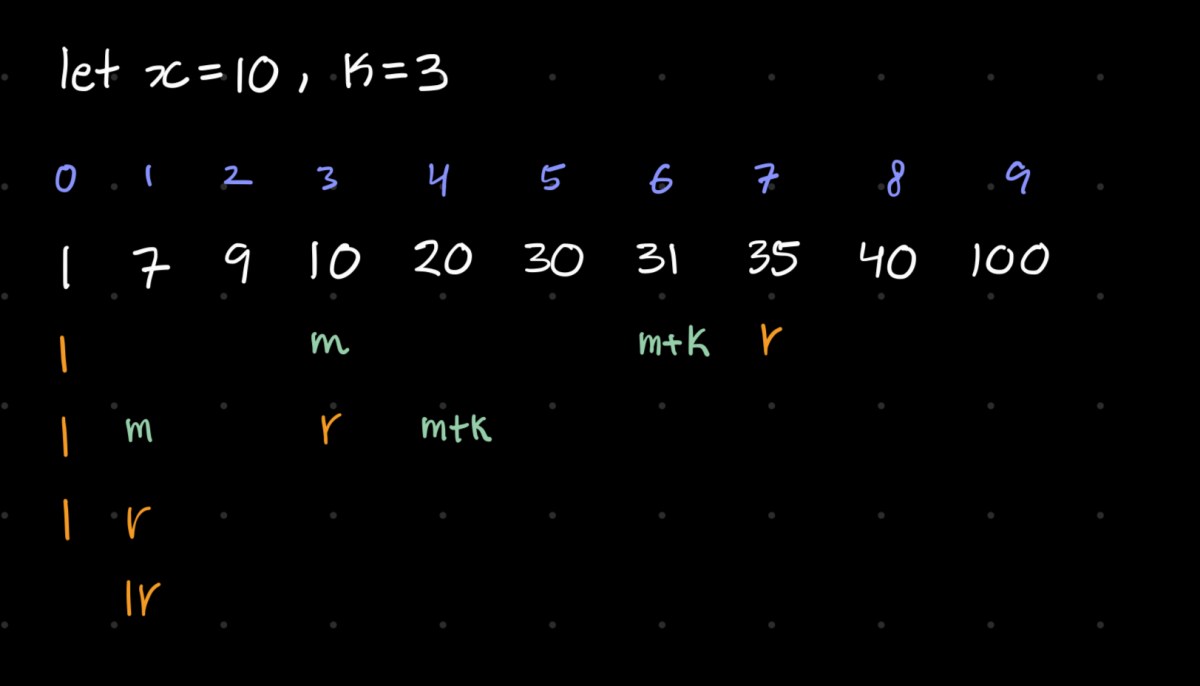
Solution 3: O(log(N−k)) – Find the left bound.
Search the left bound with binary search. Let l = 0 and r = N-k which is the maximum index that a left bound can be.
compute the mid point. Now, assuming the mid is the left bound, mid+k is the right bound. Then,
If value at mid is closer to x:
midand further cannot be the left bound because then the right bound would be more distant from x than mid.
But, since there can be an even better left bound in the left side, we continue the bin search with the left side.
so we do r = mid;
If value at mid+k is closer to x:
- index at mid or lower can’t be left bound. The left bound is somewhere between
mid+1 ~ mid+k
so we do l = mid+1;
};class Solution {public:vector<int> findClosestElements(vector<int>& arr, int k, int x) {int l = 0, r = arr.size() - k;while (l < r){int mid = (l+r)/2;if (x - arr[mid] > arr[mid+k] - x){l = mid + 1;}else{r = mid;}}return vector<int>(arr.begin() + l, arr.begin() + l + k);}
There is another way of seeing this: (from lee215’s solution post)
We compare the distance between x - A[mid] and A[mid + k] - x
If we assume A[mid] ~ A[mid + k] is sliding window
case 1: x – A[mid] < A[mid + k] – x, need to move window go left
——-x—-A[mid]—————–A[mid + k]———-
case 2: x – A[mid] < A[mid + k] – x, need to move window go left again
——-A[mid]—-x—————–A[mid + k]———-
case 3: x – A[mid] > A[mid + k] – x, need to move window go right
——-A[mid]——————x—A[mid + k]———-
case 4: x – A[mid] > A[mid + k] – x, need to move window go right
——-A[mid]———————A[mid + k]—-x——
Reflection
I think whenever using binary search, I should think about based on what criteria I will choose the left side or the right side given a mid point. This was particularly harder because I didn’t think of finding the left bound. Let’s remember that when finding a range, I can try to find only left or right bound.
 Quinsh's Programming Record